Boiler Replacement in Sheepshead Bay, Brooklyn
When an aging heating system suffers terminal structural failure or chronic inefficiency, professional boiler replacement Sheepshead Bay Brooklyn homeowners can trust is vital to securing reliable winter warmth. While our priority is always to repair functioning units, there comes a point where continued patch repairs on a compromised cast-iron block become financially impractical and mechanically risky.
Whether you own a detached home near Manhattan Beach, a brick duplex off Ocean Avenue, or a coastal property near Emmons Avenue, replacing a heating plant requires precise sizing, proper venting, and careful integration with existing radiator distribution networks. If your system is failing, call our technicians at (315) 202-8009 for comprehensive assessment and equipment guidance.
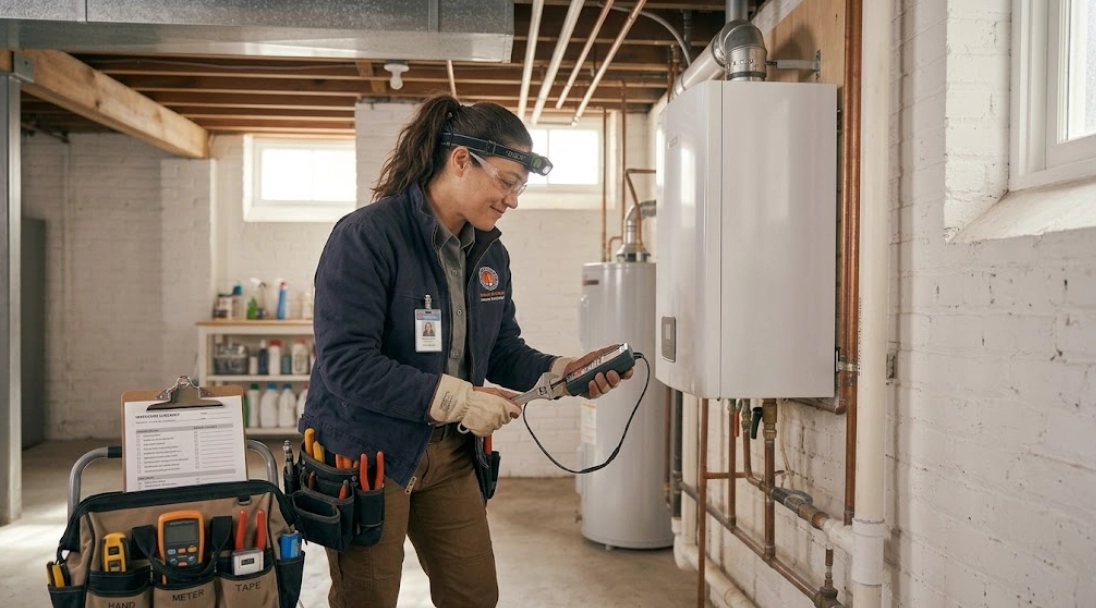
Modern boiler replacement demands precise BTU calculations and code-compliant chimney venting to maximize longevity and fuel efficiency.
Signs Your Boiler Requires Replacement Rather Than Repair
A heating unit communicates when it has reached the end of its serviceable lifespan. We evaluate the following critical indicators during on-site inspections:
- Cracked Heat Exchanger Sections: Water leaking between internal cast-iron sections cannot be sealed reliably. Firing a dry or cracked section creates a severe hazard.
- Advanced System Age: Boilers in South Brooklyn frequently operate for 20 to 30 years. Beyond this threshold, metal fatigue, internal scale calcification, and obsolete replacement parts make maintenance uneconomical.
- Severe Internal Corrosion & Scaled Waterways: Heavy rust flakes accumulating in the burner chamber restrict draft and reduce thermal transfer.
- Escalating Fuel Expenses: Outdated atmospheric boilers operate at 60% to 70% efficiency, wasting substantial gas compared to modern 85%+ atmospheric or 95% condensing equipment.
- Chronic Mid-Winter Breakdowns: If a unit requires multiple service calls each winter to keep the burner operating, full replacement provides long-term peace of mind.
Accurate Equipment Sizing: Steam vs. Hot Water
The single most common mistake in residential heating installations is improper capacity sizing. A new boiler installation Sheepshead Bay Brooklyn must follow strict thermal engineering standards:
Steam System Sizing (EDR)
Steam boilers must never be sized strictly by square footage of the house. They must be sized according to the total Equivalent Direct Radiation (EDR) of every connected cast-iron radiator. If the new boiler produces less steam volume than the radiators condense, steam will never reach the top floor. If oversized, it will short-cycle violently.
Hydronic Hot-Water Sizing
Closed hot-water systems are sized by conducting a room-by-room Manual J heat loss calculation, factoring in exterior masonry walls, insulation levels, and window exposure. Modern modulating boilers can adjust firing rates dynamically to match outdoor weather shifts.
Venting, Chimneys, and NYC Building Codes
Installing a replacement heating plant in New York City requires adherence to Department of Buildings (DOB) regulations and safety standards. Flue gases must vent cleanly through a certified chimney or direct-vent sidewall pipe. In older Sheepshead Bay houses with unlined brick chimneys, the cooler, moisture-laden exhaust from modern boilers can cause chimney deterioration. We assess chimney conditions and explain when a stainless-steel chimney liner or power-venting is required.
Oil-to-Gas Boiler Conversions
Many multi-family and single-family houses in South Brooklyn still house decommissioned or active heavy oil tanks in their basements. A professional boiler conversion Sheepshead Bay Brooklyn transition replaces bulky oil equipment with a clean-burning, quiet natural gas boiler. We coordinate gas supply line evaluations with National Grid, pipe safety valves, and assist in planning oil storage tank decommissioning through licensed environmental channels.
What to Expect During the Replacement Process
A standard boiler replacement is executed methodically to minimize heating downtime during colder weather:
- On-Site Evaluation & Radiation Survey: Measuring radiators, assessing pipe pitch, and calculating exact BTU capacity requirements.
- System Isolation & Safe Disconnection: Draining the heating loop, disconnecting high-voltage electrical connections, and severing gas supply lines safely.
- Old Equipment Removal: Dismantling the heavy cast-iron boiler and clearing the mechanical pad of debris and rust.
- New Boiler Assembly & Header Piping: Constructing a proper near-boiler piping header to deliver dry steam or balanced hydronic flow.
- Safety Controls & Permitting: Installing low-water cutoffs, pressure relief valves, expansion tanks, and backflow preventers.
- Test Fire & Balancing: Verifying combustion draft, adjusting burner manifold pressure, and checking radiator warming across every room.
Cost Factors Influencing Boiler Replacement
Investment requirements depend on several building-specific factors: whether the system operates on steam or hot water, required BTU capacity, necessary near-boiler header re-piping, chimney lining needs, electrical upgrades for modern electronic controls, and permit requirements. We explain each factor transparently before work begins.
Explore Related Heating & Plumbing Services
A new boiler often works alongside related mechanical components in your home:
- Boiler Repair: Diagnostics and component repairs when your existing heating plant can still be serviced.
- Steam Heat & Radiator Repair: Balancing steam vents, fixing banging pipes, and replacing seized radiator valves.
- Water Heater Repair: Dedicated service for domestic hot water tanks and indirect boiler coils.
- Gas Line Repair: Pressure testing, pipe upgrades, and NYC Local Law 152 compliance.
- Service Areas: Learn about our neighborhood service coverage across Sheepshead Bay, Gerritsen Beach, and Manhattan Beach.
Frequently Asked Questions About Boiler Replacement
Replacement becomes necessary when the cast-iron heat exchanger cracks or rusts through, as these structural core components cannot be welded safely. Frequent breakdowns on equipment older than 18 to 25 years, declining energy efficiency, and high repair costs compared to the price of modern equipment also indicate replacement is the more reliable investment.
Unlike forced hot-water systems which are sized based on heat loss through windows and walls, replacement steam boilers must be sized strictly to match the connected square footage of existing cast-iron radiator radiation (EDR). An undersized steam boiler will struggle to produce steam, while an oversized unit causes short-cycling, fuel waste, and intense pipe hammering.
In New York City, boiler replacements require Department of Buildings (DOB) work permits and chimney inspections. Older brick chimneys frequently require a stainless-steel liner to prevent acidic condensation from dissolving mortar joints when venting modern gas boilers.
Yes, oil-to-gas conversions are common across South Brooklyn. The process involves coordinating gas service line capacity with National Grid, installing dedicated gas piping, removing the oil burner and tank, and installing a modern gas-fired steam or hydronic boiler.